Courage in the Unknown


Insight Laos

A regular day in life
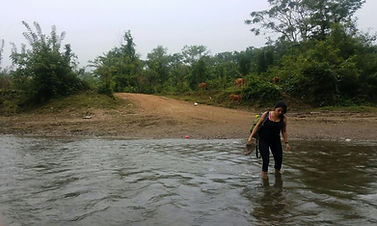
Living in a tiny village in Laos called Nong Khiaw — the hub from where we started all our projects into remote villages — looked like this. With not much clothing and yet a heart full of excitement, I have to admit that after many adventurous days, I was sometimes grateful for “ordinary” moments like these.

Lao Lao Whiskey
Lao Lao: A (very) strong beverage brewed from rice, offered in almost every village. Sometimes it was served in shot glasses, sometimes — like in the picture below — drunk through straws. My biggest concern was that the high alcohol content might make me go blind. However, it was a big no-no to refuse it.

Baci Celebrations
Whenever someone arrives as a visitor or leaves a place, Laotians hold a so-called Baci ceremony. It includes tying white strings around a person’s wrist while offering wishes for good luck, fortune, love, and protection. Each knot represents one of these wishes. The ceremony is usually accompanied by food — often sticky rice and chicken — along with fruit and Lao Lao whiskey.
.jpeg)
Finding Bombs
A reality I didn’t want to face — but eventually had to.
I never knew how heavily Laos had been bombed before moving there. When I spoke with passing tourists, most of them didn’t know either. Many were unaware of the country’s reality and its difficult history. That’s when I realized I didn’t want to be part of that kind of tourism. I preferred to live alongside people and take the time to truly understand the reality of Laos from within.
I have to admit that after moving from Laos to Ecuador, I spent around six months in a deeply sad state, after witnessing these realities and feeling unable to help further. That was when I understood that I could still contribute — by helping shine a light on their past, and also on their beautiful traditions and resilience.
Laos became my life school — where I learned from the people’s courage, resilience, and love.
.jpeg)
Free time: time to train
When I made my first visit to a village — the highest one of them all — I couldn’t reach it. After about two hours of steep hiking, I was told we still had around three more hours to go. I was devastated because I simply couldn’t continue physically. Coming from a serious knee injury and a comfortable German lifestyle, I just wasn’t prepared for that kind of extreme mountain terrain.
I had to turn back to a village by the river and explain to my boss that I wasn’t able to make it. When I was told that reaching these villages was part of the job — and that I would be fired if I couldn’t do it — I quickly understood that I needed to start training in a serious and disciplined way during my time off.
I trained hard: running up and down to the top of a viewpoint near my village, and once even walking 22 kilometers alone from one village to another in a single day. I took my training very seriously.
In the end, I became so fit that I could complete those five-hour mountain hikes faster than some of the local villagers.
.jpeg)
The Danger
Bombs weren’t enough — these kinds of crossings also put me to the test. The first time I had to cross one of these bridges, I tried to find every possible alternative route, but eventually I had to accept my fate. The bridge was about seven meters high and cracked with every step I took, with around fifteen kids following behind me.
I never really grew comfortable with crossing that bridge, but in the end, I managed to cross it without fear.

Love
There was love. I won´t mention his name nor feel the need to tell what happened nor who he was. All I honor to mention in this site is that we shared this view, so many times and found love in the remotest place. It was so special to fall for someone that could see me in my most happiest enviroment, which is helping others, finding a purpose and living out a true adventure of a lifetime. Danke M.B.

The Gear That Kept Me Going
Northface shoes:
My, did they get to experience a lot. By the end of that year I had to part goodbye from them, but they kept me comfortable, stable and safe during this adventure.
Deuter:
My dear backpack, best buy ever.
SAWYER WATER FILTER:
TRUST ME, you shouldn´t go out on an adventure without it. I was able to filtrate water from rivers, and most water resource.It even filters certain bacteria that a regular water filter wouldn´t.
It´s a life saver and a basic gadget to have.
Swiss Army knife: Basic.
Quechua Rain Jacket:
Honestly, even after having been dragged through the toughest terrain (and later also in the Amazon), my Quechua rain jacket remains intact up to this day, especially the zipper.
Lifesaving book:
Wo es keinen Arzt gibt" (Original:
Where There Is No Doctor) by David Werner. It saved me on s o MANY ocations, especially in the Amazon when a kid shot his finger off. This is a must take when going to remote locations.
A very large first aid kit:
It´s basic to have a large first aid kit, checked by a tropical doctor prior to departure. Don´t leave without this.
Rescue Blanket!!!
They have saved me on more than several ocations. Light to carry, basic to survive extremeness.
Sleeping Bag:
Initially I hesitated, since it was a bit heavy and yet, what would I have done without one. Thanks Hayley for lending me yours!
Dry Bag to put most valuable belongings there (passport, phone, keys, etc.)
Compass: I luckily never got to use it, but felt safer that I had one.
How to Read a Compass — A Simple Field Guide
In remote places, signal disappears, batteries die, and trails fade — but a compass will always tell you the truth. Learning to read one is easier than most people think, and it can change how confidently you move through the world.
A compass has one job: the red needle always points North. That’s your anchor.
Hold the compass flat in your hand and let the needle settle. Once it stops moving, you’ll see where North is — and from there you automatically know South, East, and West. Even this alone can keep you oriented when paths become unclear.
When you want to walk in a specific direction, turn the compass dial until your chosen direction lines up with the arrow on the base. Then rotate your body until the red needle sits inside the marked North arrow on the dial. Hikers often call this “putting red in the house.” Once it’s aligned, follow the direction arrow — that’s your path.
In the field, I learned something important: don’t just check once and walk blindly. Check often. We humans drift without noticing — especially when we’re tired, emotional, or walking through dense terrain.
A compass doesn’t replace intuition — it supports it. It gives structure to courage and clarity to movement. When you know where North is, every other direction becomes a choice, not a guess.
.jpeg)
Menstruating in the wild
A subject that is important to mention: none of the remote villages had Western toilets. The rule was to carry a stick to shoo away the pigs that followed us everywhere — and to hope for a quick bowel movement.
When I was on my period, I tried to use my menstrual cup, but quickly realized that the lack of water in the houses and the hygienic conditions didn’t allow it. So I switched to pads and tampons, always carrying a bag with me and keeping them there until I could reach a place with a garbage bin.
For the women in the villages, this was also a major issue. Menstruation was frowned upon and rarely talked about. Some girls had small huts outside the village where they had to stay during their period — separated and excluded from daily life.
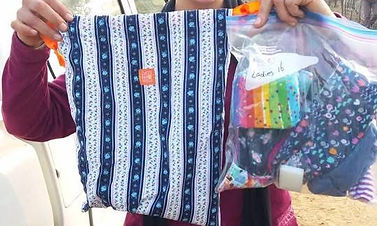
I was fortunate to meet representatives of the NGO Days for Girls, who provided menstrual kits in a colorful and approachable way. Each kit included soap, a plastic bag, and reusable pads designed to absorb large quantities of blood. We visited several villages to distribute the kits and to open conversations around women’s health topics, sometimes together with our volunteer female doctors.
Many women were grateful to finally have a safe space to talk about these subjects.
Life in Caves
From 1964 to 1973, during the Vietnam War, Laos was subjected to an intense U.S. bombing campaign that later became known as the “Secret War.” Over nine years, more than 2 million tons of ordnance were dropped in approximately 580,000 bombing missions — making Laos the most heavily bombed country per capita in history.
The scale was staggering: on average, a planeload of bombs was dropped every eight minutes, 24 hours a day, for nine consecutive years. The primary objective was to disrupt North Vietnamese supply routes along the Ho Chi Minh Trail and to support anti-communist forces in the region.
During these years, many Laotian families survived by living in caves for extended periods, using them as shelter from the continuous air raids. Entire communities adapted their daily lives underground.
The war’s impact did not end when the bombing stopped. It is estimated that around 30% of the bombs did not explode on impact, leaving millions of unexploded cluster munitions — often called “bombies” — scattered across fields and villages. These remnants continue to cause injuries and deaths decades later.
In total, more bombs were dropped on Laos during this period than were dropped by the United States during all of World War II.

Being a Female General Manager
Apart from wanting to show my respect toward the villagers, I also wanted to show that I wasn’t afraid to get my hands dirty. I always felt that I had — and wanted to give — my maximum effort: digging holes for water tanks and toilets, and carrying construction materials. Most importantly, I wasn’t there just to observe and lead — I wanted to be part of the village.
Even without a shared spoken language, we communicated through action and by working side by side.
There was not much else to do there anyway, since walking around was considered dangerous due to unexploded bombs that might still be hidden in the forest. I have to admit that I was often very nervous when digging, because we never knew what we might find underground.
.jpeg)
The Blair Witch Project
In my local village, there was a viewpoint that I loved to hike up to. One day — I guess I was bored because I wasn’t out in the communities — I thought it would be a great idea to hike up there and sleep alone. Even though my gut feeling told me it was a bad idea, especially since I didn’t have a tent with me, I decided to do it anyway.
I packed far too many water bottles, my sleeping bag, and a mat, and thought I would be fine. The hike took ages because I was carrying about 12 kilos of gear — everything except the most basic necessity: a tent.
As I was nearing the top, I suddenly had a strange sense of déjà vu, like a scene from The Blair Witch Project, even though I don’t remember actually watching it. The forest looked exactly like something out of that movie. By the time I reached the top, it was almost completely dark, but I decided to stay because I was too exhausted to go back down.
I immediately regretted my decision and felt a bit shocked at myself. I may be adventurous — but in that moment I was also just plain reckless.
Luckily, I had two things: phone signal and a Valium pill that was sold without prescription at the local pharmacy, which I occasionally took for anxiety attacks (at that time I didn’t yet know that my thyroid levels were completely off).
I texted a friend who had told me all day that this was a bad idea — and he came to rescue me, sprinting up the mountain in the dark.
I strongly do not recommend going against your own instincts and exposing yourself to risks that could turn fatal. If something had happened up there, no one would have heard me. There were snakes and other creatures around.
I may have lived many adventures independently, but I was almost always around people — sometimes strangers, sometimes people whose language I didn’t speak — yet still connected through a sense of community.
.jpeg)
The Uncomfort
I won’t lie.
The first time I slept in a hut like this, on my first field trip, I could hardly sleep. There was rat droppings everywhere, bats were flying around, and who knows what else was lurking in the dark. This hut had almost never been used by guests, and therefore it was in that condition.
Usually we slept in the villagers’ houses, and they were always very clean. I never saw a hut like this again — but it was certainly a memorable way to begin my Laotian adventure. What I learned from this experience is how useful a tent could be. In this case, I could have set up a tent inside the hut, which would have provided proper shelter and reduced the risk of exposure to rat droppings. Instead, I slept with a mask covering my nose and mouth, and we cleaned the hut as thoroughly as possible before lying down.

The Evolution of Fear
When I first arrived in Laos, I quickly realized how unprepared I actually was for real field conditions. I had assumed that growing up in Ecuador and even living on an island in Mozambique surrounded by cobras had already toughened me — but I was wrong. This was before my time in the Amazon, and I had completely underestimated the world of insects and jungle terrain.
From leeches covering my legs while hiking to remote villages in the rain, to scorpion stings, to eventually learning to eat insects without hesitation — the learning curve was steep and very real.
Looking back, Laos was my true initiation. It prepared me for the Amazon — and the Amazon, in turn, prepared me for life.

Dengue, Dengue, Dengue
I’ve been sick a couple of times in my life — from very strong kidney infections to a kidney operation. I thought I knew pain — until the morning I woke up with dengue. Luckily, now I see that God was by my side. I wasn’t alone when I was supposed to be — since at that time there were no volunteers in Nong Khiaw, nor in Laos — but I had met a wonderful, loving, and caring Dutch friend along the way and had invited her to visit me in my tiny local village. We had been partying and sightseeing in Vang Vieng and Luang Prabang before, and on the day we arrived in Nong Khiaw, I started to feel sick in the evening. Thinking it was only a cold, I took a pill and we had some beers and good food.
The next morning I woke up and rushed to the toilet to vomit. I noticed it was something stronger than a regular cold because suddenly I felt I couldn’t even walk. I didn’t have the strength to make the three-minute walk from my house to the hospital — it was impossible. My friend managed to get a taxi (there was only one in the entire village, I think, since it was so small), and we went to the local hospital — the same one where we also sent volunteer doctors. Since there were no machines to run blood tests, the doctor assumed it was some type of brain infection. According to my international insurance, this was very serious, and they almost arranged a plane from Luang Prabang to fly me to Thailand. However, I felt so weak that just the thought of flying overwhelmed me, so I proposed going to a bigger hospital in Luang Prabang to do bloodwork there. The insurance agreed.
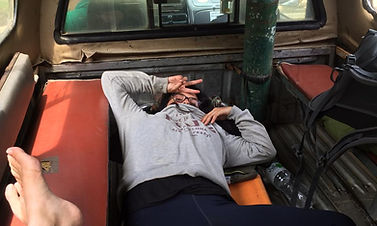
At the sight of the “ambulance,” I almost fainted. What looked like a beach lounge chair — stained with dried blood from previous patients — was supposed to be the ambulance bed for a patient. Another test of my patience and especially my heart. I felt so sorry seeing those conditions and couldn’t believe that in the back of the truck (because it was nothing more than that) there was only an oxygen tank and nothing else — besides my dear friend who accompanied me. The five-hour ambulance ride was pure hell. I had to beg the driver to slow down, because I was sure that if I didn’t die from dengue, it would be from the speed of that car.
When we arrived at the hospital — supposedly the best in Luang Prabang — I was once again in shock. The hospital floor was very dirty, the toilet had no seat or cover, and in my “private room” the shower was just a big bucket of water — stale water from who knows when. I was scared of getting sick again just from the look of it.
My bloodwork showed it was dengue and, luckily, not a brain infection. I felt relieved — and yet afraid because of the hospital conditions. My room was the “luxury” one due to my insurance, but the ER was a nightmare. I was surprised to see there were no monitors, nothing automated, and family members sleeping on the floor next to their loved ones. I had never seen anything like it. This is what I consider material poverty — in a country with such human and cultural richness. I cried for the people, for the country, for myself, for humanity. When I realized that at night there was not a single doctor or nurse on the floor, nowhere to be found, and I was extremely thirsty from the fever with no one to help me, I remembered that next door there was a children’s hospital — luckily in much better condition, since it was subsidized by an American NGO. With the last bit of energy I had left, I went there crying and asked for water. “You poor thing,” I remember the American nurse saying. They were well aware of the conditions next door and even offered that I could sleep there, but I refused. Looking back now, I don’t even remember how I got back — whether alone or with help.
The following days got better and I slowly began to recover. Two of my dearest volunteers came back to Laos to look after me. Danke vielmals für alle Ewigkeiten, Silke und Klaus!
They stayed with me after I left the hospital, and we spent a couple of days recovering in Luang Prabang. Soon I began to feel the after-effects of dengue: itching hands, extreme hair loss, no appetite, and of course weight loss. Since I didn’t know at the time that my thyroid was also completely off, I couldn’t understand the rapid heartbeat — but for obvious reasons, I didn’t want to see another doctor. At the hospital I saw a doctor once when I was admitted and never again. The nurses changed the IV once a day but otherwise never came to check on me or take vital signs — nothing. I had to go out to the street myself to get food. After the third day, I got used to it.
Seven days was the total time I stayed in the hospital, and I had never felt that sick or in that much pain before. I’m so thankful my body recovered — and I completely underestimated the effect that such a small mosquito could have.
.jpeg)
Useful Information
Rat excrement can pose serious health risks because it may carry harmful bacteria, viruses, and parasites. One of the most well-known dangers is hantavirus, which can be transmitted when dried droppings, urine, or nesting materials are disturbed and particles become airborne and are inhaled. Exposure can also spread diseases such as leptospirosis and salmonella through contaminated surfaces, food, or water.
Risk increases in enclosed or poorly ventilated spaces. It’s important to avoid sweeping or vacuuming dry droppings, use protective gear (mask and gloves), ventilate the area, and disinfect properly before cleaning.


